Betta Fish at the Goldfish Market: The Small-Flat Fish, and the Tank It Actually Needs
Hong Kong's Goldfish Market is a tropical-fish market as much as a goldfish one. A peer-reviewed survey of this exact street counted 540 species of freshwater fish on sale, and the market's own care page says the bulk of the trade, by species count, is the tropical trade. Among the small tropical fish on the racks, the one a reader in a small flat is most likely to be sold — and the one with the worst advice in circulation — is the betta.
The problem is not the fish. It is the container the shop displays it in. The betta is a genuinely small, genuinely forgiving fish, but the pink jar or the plant vase it is often sold in is not a home, and this page gives you the one number the rack never gives: a peer-reviewed minimum tank size, with the furnishings that go with it.
\U0001f41f Short answer
A betta — the Siamese fighting fish, Betta splendens — is a small warm-water fish, at most about 6.5 cm long, and it does suit a small Hong Kong flat. But not in a jar or a vase. A peer-reviewed study in the journal Animal Welfare recommends a minimum tank size of 5.6 litres for displaying or selling bettas, and tanks larger than that for keeping one at home — in every case filled out with gravel, live plants and a hideout. Bettas need warmer water than goldfish, and males are kept one to a tank.
What a betta actually is
The betta is the Siamese fighting fish, Betta splendens Regan, 1910. It belongs to the family Osphronemidae, the gouramies, in the subfamily Macropodusinae. FishBase records it as native to the Mekong basin, living in the standing waters of floodplains, canals and rice paddies — not in fast rivers, and not in the open sea. It grows to a maximum of about 6.5 cm total length, and FishBase's maximum reported age for the species is 2 years.
Two of its habits explain most of what a keeper has to know. It is an air breather: it has a labyrinth organ and comes to the surface to gulp air, which is why it can survive in the still, low-oxygen water of a paddy. And it is a bubble-nest builder, which is a breeding behaviour. In the wild it feeds on zooplankton and insect larvae.
As for the name: bettas are territorial, and FishBase is blunt that "males will fight each other." That is the whole reason for the one rule that overrides almost every other piece of advice about them — keep one male to a tank. Multiple males must not be housed together.
The tank it actually needs
This is the part the market's pink-jar shelf never tells you. A study published in Animal Welfare in November 2024 (Clark-Shen and colleagues) tested how tank size and furnishings affect betta welfare, and its recommendation is a flat, quotable number. For the display and sale of bettas, the recommended minimum tank size is 5.6 litres. For keeping a betta at home, the study's recommendation is a tank larger than that — and every one of those tanks should contain gravel, live plants and hideouts. A bare glass box of water is not what the recommendation describes.
The evidence behind it is straightforward. The team rotated 13 male bettas through furnished tanks of 1.5 L, 3.3 L, 5.6 L and 19.3 L, plus a 19.3 L barren tank, over 31 days. In the smaller tanks and in the barren one, the fish showed more inactivity and more "abnormal" behaviours — hovering and stereotypic, repetitive swimming. The largest furnished tank produced the most natural foraging. In other words, both the size of the tank and what is inside it change how the fish behaves, and the small, empty container makes both worse.
The practical requirements that follow are short:
| What | The requirement, and where it comes from |
|---|---|
| Tank size | At least 5.6 litres to display or sell a betta; a larger tank for one kept at home (Animal Welfare, 2024). Treat 5.6 L as the floor for a shop display, not the target for your living room. |
| Furnishings | Gravel, live plants and hideouts — the study's tank recommendation specifies all three (Animal Welfare, 2024). |
| Water | Warmer than a goldfish tank. Bettas are tropical; the site's own care page notes that tropical fish need warmer water than goldfish and are not goldfish tank mates. No Celsius figure is printed here because none was confirmed against an authority — check the range on the shop's or a vet's guidance rather than guessing. |
| A lid or cover | A betta can jump; keeping the tank covered is ordinary aquarium practice rather than one authority's written rule. |
| Stocking | One male per tank. Males fight each other (FishBase). |
Why the jar, cup and vase are the problem
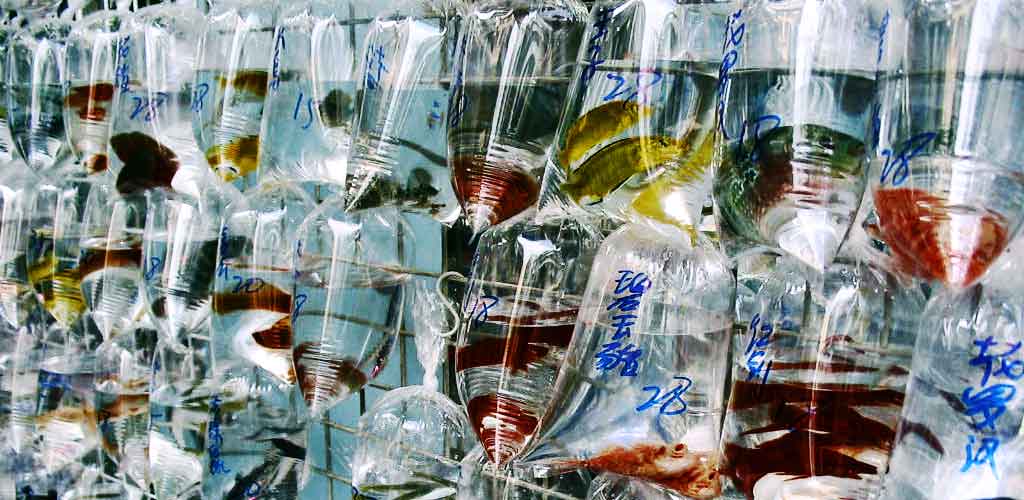
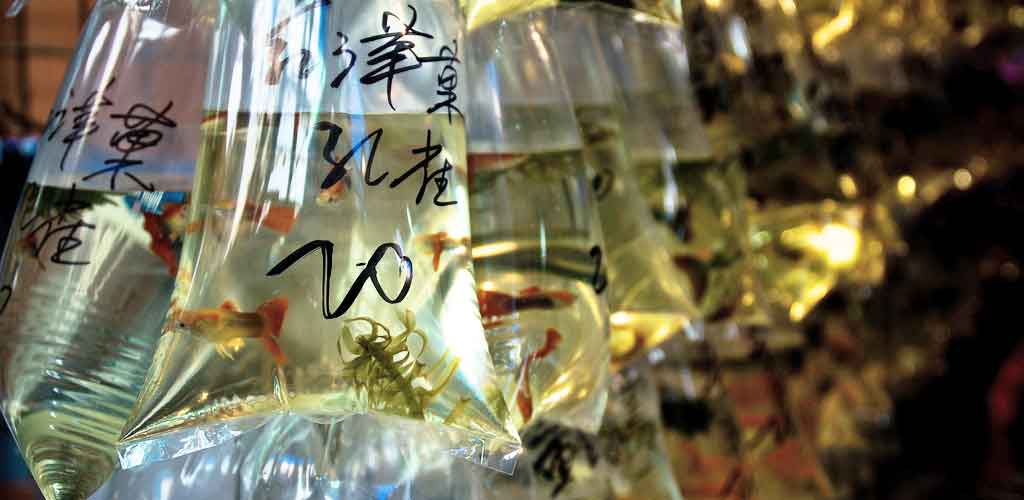
The way bettas are commonly sold is the exact thing the sources warn against. The fish are still kept and sold in small jars, cups and even plastic bags — that is both the framing of the 2024 study and the observation of its lead author. FishBase, whose species entry is written for the trade as much as for hobbyists, records that while the many colourful varieties are popular aquarium fish, "the holding of the males in very small containers should be discouraged." That is not a welfare blogger's opinion; it is the database entry for the species.
Two more points, so the criticism is fair and specific rather than general.
First, the problem is the container, not the hobby. FishBase gives a breeding tank of about 20–30 litres — many times the jar — as the working size for spawning bettas. The animal is happy in water; it is the thimble that fails it.
Second, some of the fish themselves are bred into difficulty. The RSPCA notes that selective breeding can have negative welfare effects, and gives the "rose-tailed" betta — a strain bred for very heavy, flowing tails — as an example, saying such extreme fins "can cause health problems." If you want a fish you can house honestly, a heavy-finned show strain is the harder, not the easier, choice.
Before you buy one at the market
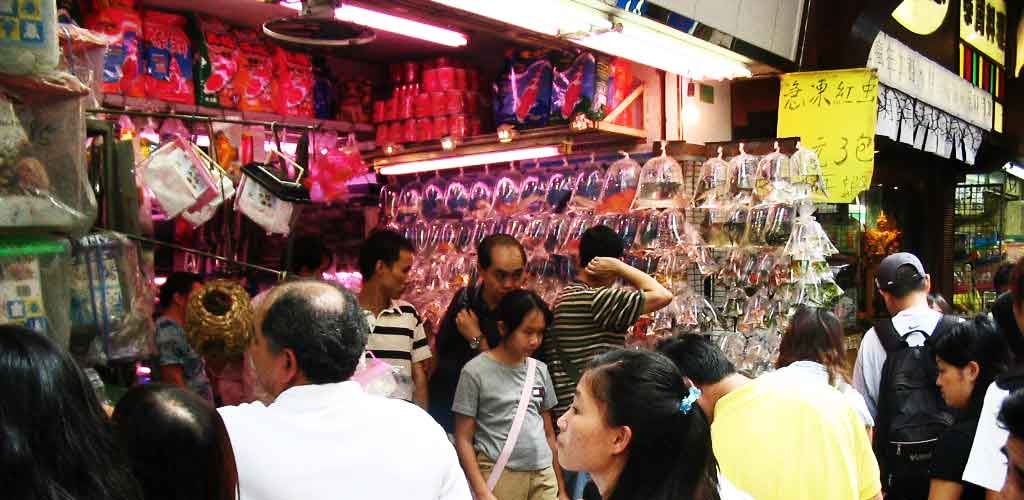
The Goldfish Market is a good place to see the tropical trade up close, and bettas are part of it. Visitor guides to the street list "exotic bettas" among what is sold along Tung Choi Street, and the market's tropical side is well established by the Oryx survey and the site's own care page. That said, treat any specific shop's stock as something to check on the day, not a guarantee.
Three practical rules before you pay:
- Have the tank before the fish. Do not buy the betta and the container in the same trip and improvise. If the only thing the shop can offer is a vase or a jar, you do not yet have a tank, and the 5.6 litre minimum is the number to shop against.
- Settle how you are getting it home first. A bagged fish cannot ride the MTR — Hong Kong's MTR by-laws prohibit animals on the network unless MTR permits otherwise, and MTR's permissions cover dogs and cats, not fish. See how to get to the Goldfish Market for the logistics, and plan a taxi or a walk instead of the train.
- Ask two questions. What is the shop keeping it in now, and how warm does your room run? A betta is warmer-water than a goldfish, so a cold flat in a Hong Kong winter needs a plan for heat, not just a bowl.
For the wider picture of what is on sale and how the purchase works, see Goldfish Market species and care and what to buy at the market. If you are planning the visit around it, check opening hours; and if you came to the market for its traditional fish — the goldfish and koi kept for luck — that is a different fish with a different set of expectations, covered in the feng shui goldfish guide.
FAQ
Can a betta live in a bowl or a vase?
No — not honestly. The peer-reviewed recommendation is a minimum of 5.6 litres for displaying or selling a betta, with gravel, live plants and a hideout, and a larger tank for keeping one at home. A bowl or vase is smaller than the display minimum and usually bare inside it, which is the combination the 2024 study found produced the most inactive and abnormal behaviour.
How big a tank does a betta need?
At least 5.6 litres for a display or sale tank, and larger than that for a betta kept at home — furnished with gravel, live plants and hideouts throughout. FishBase's breeding figure of about 20–30 litres gives a sense of how much water a betta can use when it is given more.
Can I keep two bettas together?
Not two males. Bettas are territorial and FishBase states plainly that males will fight each other. Keep one male to a tank.
Are bettas cold-water fish like goldfish?
No. A betta is a tropical fish and needs warmer water than a goldfish, which is also why the market's own care page says tropical fish are not goldfish tank mates. Plan for warmth, not for a cold bowl.
Sources
- FishBase, species entry for Betta splendens (Siamese fighting fish) — family Osphronemidae, Mekong-basin range, the 6.5 cm maximum length and 2-year maximum reported age, the labyrinth air-breathing and bubble-nest habits, the 20–30 L breeding tank, the note that holding males in very small containers "should be discouraged", and "males will fight each other": fishbase.se.
- Clark-Shen et al., "The effect of tank size and environmental enrichment on the welfare of male betta fish", Animal Welfare, November 2024 — the 5.6 L display/sale minimum and larger home recommendation, the gravel/plants/hideout requirements, the 1.5 L, 3.3 L, 5.6 L and 19.3 L furnished tanks and the 19.3 L barren tank over 31 days, and the inactivity and abnormal-behaviour findings: pmc.ncbi.nlm.nih.gov.
- FishBase's IUCN record for Betta splendens — conservation status Vulnerable (VU) (A2ace), assessed 25 February 2011: fishbase.se/summary/4768.
- RSPCA (UK), fish welfare guidance — that selective breeding can have negative welfare effects, with the "rose-tailed" betta and its heavy tails as an example that "can cause health problems": rspca.org.uk.
- The Straits Times, report on the 2024 betta study — that bettas are still sold in small jars and cups, the lead author's observation, and the secondary background that bettas are native to Thailand (also Malaysia, Indonesia and Cambodia) and that Thailand has over 1,000 betta farms exporting more than 20 million fish (2018 figure). Attribute as press reporting, not primary: straitstimes.com.
- HongKong Trip, Mong Kok area guide — a visitor guide listing "exotic bettas" among what is sold on Tung Choi Street. Secondary, attributed as "visitor guides list": hongkong-trip.com.
- This site, Goldfish Market species and care — that tropical fish need warmer water than goldfish and are not their tank mates. The Oryx (2026) street survey of 540 freshwater fish species is cited on that page.
Three things are deliberately not printed above, because no reached authority confirmed them for Hong Kong: a water temperature in degrees (the page says only "warmer than goldfish"), a price for a betta on this street, and any claim that a specific shop stocks them. The lid-and-cover point is ordinary hobby practice, and is labelled as such. All sourced figures were checked against the primary pages on 2026-10-27.