Goldfish Market Weather: When to Visit, and What a Typhoon or Rainstorm Day Does
A visit to Tung Choi Street's Goldfish Market is a half-hour walk down an open street, so the weather is not a side note here — it is the thing that decides the day. This page answers two questions with the Hong Kong Observatory's own figures: which month should I pick, and if a typhoon or a black rainstorm hits while I am in Hong Kong, is the street open and can I still get there?
🌦️ Short answer
Pick November or December. The Hong Kong Observatory's own words are that "many people regard these as the best months of the year", with pleasant breezes, plenty of sunshine and comfortable temperatures. May to September is when the heat, the rain and the typhoons are: about 80% of the year's rain falls in May–September, June and August are the wettest months, and July–September is the most likely window for a tropical cyclone. On a warning day it is the transport, not the shop addresses, that changes: at tropical cyclone warning signal No. 8 the buses and the MTR Bus stop and the underground MTR runs a limited service, while each independent shop on the street decides for itself whether to open, because no authority publishes a closure rule for this market.
Month by month: the Hong Kong Observatory's 1991–2020 normals
Every figure in the table below is a 1991–2020 climate normal published by the Hong Kong Observatory (HKO) — that is, a 30-year average, not a forecast. The "days with signal No. 8+" column is the mean number of days in each month that Hong Kong carried a tropical cyclone warning signal of No. 8 or higher; the year figure is 2.43 days, and the whole of it sits between June and October.
| Month | Mean max / mean / min temperature (°C) | Total rainfall (mm) | Mean days with signal No. 8+ | Mean relative humidity (%) |
|---|---|---|---|---|
| January | 18.7 / 16.5 / 14.6 | 33.2 | 0 | 74 |
| February | 19.4 / 17.1 / 15.3 | 38.9 | 0 | 79 |
| March | 21.9 / 19.5 / 17.6 | 75.3 | 0 | 82 |
| April | 25.6 / 23.0 / 21.1 | 153.0 | 0.13 | 83 |
| May | 28.8 / 26.3 / 24.5 | 290.6 | 0.03 | 83 |
| June | 30.7 / 28.3 / 26.5 | 491.5 | 0.27 | 82 |
| July | 31.6 / 28.9 / 26.9 | 385.8 | 0.53 | 81 |
| August | 31.3 / 28.7 / 26.7 | 453.2 | 0.80 | 81 |
| September | 30.5 / 27.9 / 26.1 | 321.4 | 0.67 | 78 |
| October | 28.1 / 25.7 / 23.9 | 120.3 | 0.13 | 73 |
| November | 24.5 / 22.2 / 20.3 | 39.3 | 0 | 72 |
| December | 20.4 / 18.2 / 16.2 | 28.8 | 0 | 70 |
| Year | — | — | 2.43 | — |
Source for every cell: Hong Kong Observatory, Monthly Meteorological Normals for Hong Kong (1991–2020), hko.gov.hk/en/cis/normal/1991_2020/normals.htm. Averages, not forecasts — an August of 0.80 "No. 8 days" means August averaged about four-fifths of a day at signal No. 8 or above across the 30-year period, not that any given August will have one.
Season by season, in HKO's own descriptions:
- January – February is the cloudy, dry end of winter: occasional cold fronts can take urban temperatures below 10 °C, and these are the two driest months (33 mm and 39 mm of rain). Few crowds, but bring a jacket.
- March – April turns milder and more humid, and it is the fog month: HKO records a mean of 1.47 fog days in March and 1.10 in February (visibility under 1,000 m), and warns that air traffic and ferry services are occasionally disrupted under drizzle and fog. March is also the wettest of the four "dry" months on the sunshine side, with the year's lowest sunshine, about 100 hours.
- May – August is "hot and humid with occasional showers and thunderstorms": afternoon temperatures often exceed 31 °C and even at night it sits around 26 °C with high humidity. June (491.5 mm) and August (453.2 mm) are the two wettest months of the year.
- September – October cools off but stays in the typhoon window — September averages 0.67 days at signal No. 8 or higher, more than any month except August — and October is the sunniest month on record (about 198 hours).
- November – December is the pick: HKO's own summary says that "during November and December there are pleasant breezes, plenty of sunshine and comfortable temperatures. Many people regard these as the best months of the year." November is also the least humid month of the year at 72%, and neither month carries any historical typhoon-signal day.
Typhoon season, translated
HKO states that May to November are the months during which tropical cyclones may strike Hong Kong, with July to September the most likely; the Observatory's warning page adds that such storms are "particularly prevalent during September". The warning itself is a numbered tropical cyclone warning signal — not a "typhoon level" — and the numbers are wind-speed thresholds, not severity adjectives:
| Signal | What it means (HKO) |
|---|---|
| No. 1 Standby | A cyclone is centred within about 800 km of Hong Kong. |
| No. 3 Strong Wind | Sustained winds of 41–62 km/h, gusts may exceed 110 km/h. |
| No. 8 Gale or Storm | Sustained winds of 63–117 km/h, gusts may exceed 180 km/h, blowing from the quarter indicated (8NE, 8SE, 8SW or 8NW). |
| No. 9 Increasing Gale or Storm | The gale is increasing in strength. |
| No. 10 Hurricane | Sustained winds of 118 km/h or above, gusts may exceed 220 km/h. |
Since 1987 HKO has also issued a Pre-No. 8 Special Announcement when signal No. 8 is expected within two hours. That two-hour warning is the practical trigger for a visitor: it is the point at which transport starts winding down, and the point at which you should be deciding whether to head back.
When a warning is up: what stops, what keeps running
Heavy rain has its own scale, separate from the numbered cyclone signals. A rainstorm warning is coloured, not numbered, and the thresholds are rain rates: Amber is heavy rain exceeding 30 mm in an hour, Red exceeding 50 mm/h and Black exceeding 70 mm/h. Black's published instruction is simply to stay indoors or take shelter. HKO notes the criteria are for guidance only — Red can be issued without Amber first — and places the rainy season as normally April to September, heaviest in May and June.
What actually changes on the ground, from the operators' and the Government's own published rules:
- MTR (underground). At signal No. 1 and No. 3, services run normally; during the Pre-No. 8 announcement MTR adds trains if needed. At signal No. 8, services start normally and then drop to "limited service with reduced frequency as the storm gets closer". At No. 9 or No. 10, open-air sections and the Light Rail are suspended, but the underground sections keep a limited service. Source: MTR, "Travel tips during typhoon".
- MTR Bus. Suspended three hours after signal No. 8 is issued, and it stays suspended at No. 9 and No. 10.
- Buses and green minibuses. The Government told the Legislative Council that franchised buses and green minibuses are "generally suspended" at signal No. 8.
- Taxis. Not required to suspend — drivers keep operating at their discretion, but must charge metered fares with no surcharge.
- The person behind the counter. Even if the street is passable, staff may not be there. The Labour Department's Code of Practice in Times of Adverse Weather and "Extreme Conditions" tells employers that when signal No. 8 or higher is in force they "should not require employees to return to workplaces". The Goldfish Market is a row of independent businesses, so what opens on a given warning day is decided shop by shop.
What that means on Tung Choi Street
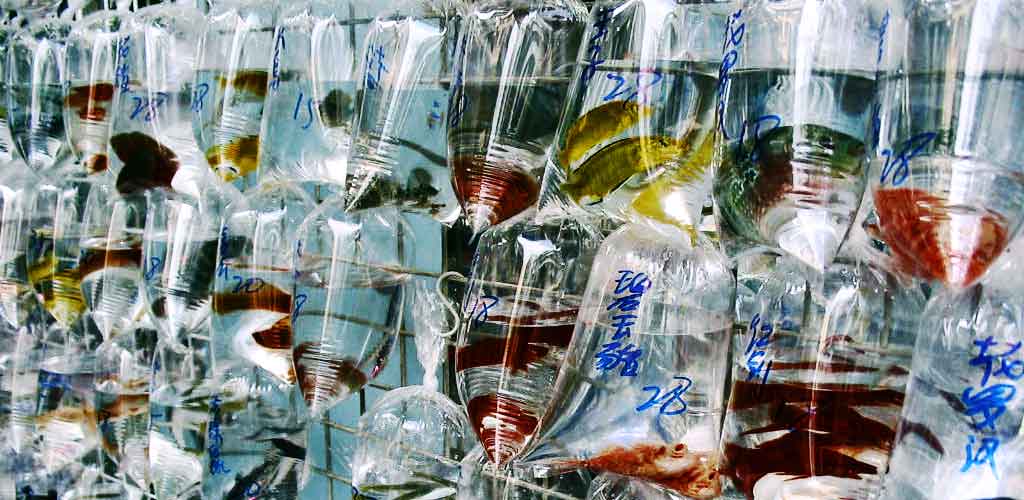
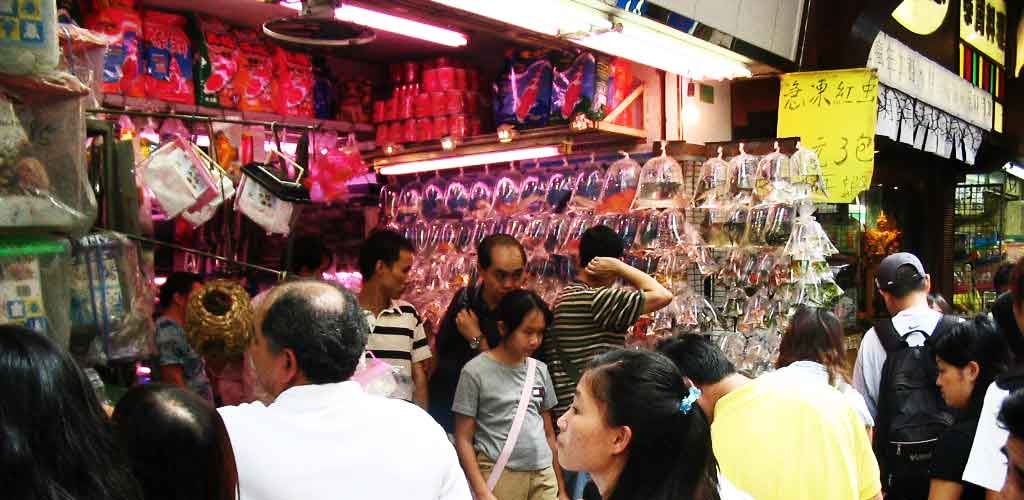
The Goldfish Market is not a gated market with a single sign on a single door: it is roughly 300 metres of shopfronts on both sides of Tung Choi Street, free to walk, with no market-wide opening schedule because each shop is its own business. That structure is the whole answer to "is the market open in a typhoon". No authority publishes a closure rule for this market — HKO regulates warnings, MTR and the bus operators regulate the transport, and the Labour Department regulates whether employers may require staff to travel; none of them closes a shop. So do not plan around a published closure. Plan around the two things that are published and predictable: whether the transport is running, and whether the staff have been released. If a No. 8 signal is up and the MTR Bus has stopped, a trip across town to look at a street of shops is a poor use of a warning day — better to move the visit to a fair-weather morning and check the opening-hours page for the time of day that suits.
Frequently asked questions
Which month is best to visit the Goldfish Market?
November or December — the months the Hong Kong Observatory itself calls the ones many people regard as the best of the year, with comfortable temperatures (mean highs of 24.5 °C and 20.4 °C) and the year's lowest rainfall, and no historical typhoon-signal days. Remember only that the market is a street of independent shops with no market-wide schedule, so a fair-weather day is necessary but not sufficient.
What if a typhoon is forecast while I am in Hong Kong?
Watch for the Pre-No. 8 Special Announcement, which HKO issues about two hours before it expects to raise signal No. 8. That is your window to travel before the MTR drops to limited service and the MTR Bus stops three hours after No. 8 is issued.
Does the MTR stop during a typhoon?
Not entirely. At No. 8 the MTR runs a reduced, limited service; at No. 9 and No. 10 the open sections and Light Rail stop, but the underground sections continue on a limited service. The MTR Bus is the service that suspends.
What about heavy rain, without a typhoon?
A Black rainstorm warning means rain is falling faster than 70 mm an hour, and the published advice is to stay indoors or take shelter. Between showers the street is walkable, but the shops are open to the pavement, so match your visit to a dry spell rather than the middle of a storm.
Sources and how to check them
- Hong Kong Observatory, "Climate of Hong Kong" — the seasonal descriptions, "many people regard these as the best months of the year", the May–November / July–September typhoon season, and the 80%-of-rain-in-May-to-September figure: hko.gov.hk/en/cis/climahk.htm.
- Hong Kong Observatory, Monthly Meteorological Normals for Hong Kong (1991–2020) — every temperature, rainfall, humidity, sunshine, fog and tropical-cyclone-signal figure in the table: hko.gov.hk/en/cis/normal/1991_2020/normals.htm.
- Hong Kong Observatory, "Tropical Cyclone Warning Signals in Hong Kong" — the wind thresholds for each signal number and the Pre-No. 8 Special Announcement: hko.gov.hk/en/informtc/tcsignal.htm.
- Hong Kong Observatory, "Rainstorm Warning System" — the Amber / Red / Black thresholds and the "stay indoors or take shelter" advice: hko.gov.hk/en/wservice/warning/rainstor.htm.
- MTR, "Travel tips during typhoon" — normal service at No. 1/No. 3, limited service at No. 8, underground-only at No. 9/No. 10, and the MTR Bus suspended three hours after No. 8: mtr.com.hk.
- HKSAR Government, press release 1 November 2023 — the Legislative Council reply that franchised buses and green minibuses are "generally suspended" at signal No. 8 and that taxis are not required to suspend: info.gov.hk.
- Labour Department, Code of Practice in Times of Adverse Weather and "Extreme Conditions" — the instruction that employers "should not require employees to return to workplaces" at signal No. 8 or above: labour.gov.hk.
- The market's own structure — 300 metres of shopfronts, free to walk, and "no market-wide opening schedule because each shop is its own business": our own sourced Species & Care page, which took that from the Hong Kong Tourism Board's market listing and the Government's "Hong Kong Fun in 18 Districts" entry.
One item is deliberately left open. No authority publishes a rule that the Goldfish Market closes during a typhoon, and this page does not claim one. HKO, MTR and the Labour Department govern warnings, transport and staffing, not shop doors, so the "When a warning is up" section describes the published consequences rather than quoting a market closure. Check the live HKO warning page on the day, treat the transport as the deciding factor, and give the independent shops the same allowance you would give any small business.
Planning the rest of the trip? The opening hours and best times page covers the time of day, how to get to Tung Choi Street covers MTR exits and routes from the airport, what to buy covers the shopping, and the Species & Care guide covers the fish themselves.